Ghent · St Bavo's Cathedral
The Ghent Altarpiece, panel by panel
A morning-to-late-afternoon look at the twelve-panel work by Hubert and Jan van Eyck, its missing panel, restoration, and display inside St Bavo’s Cathedral.
- Part of town
- the cathedral quarter
- Give it
- an hour
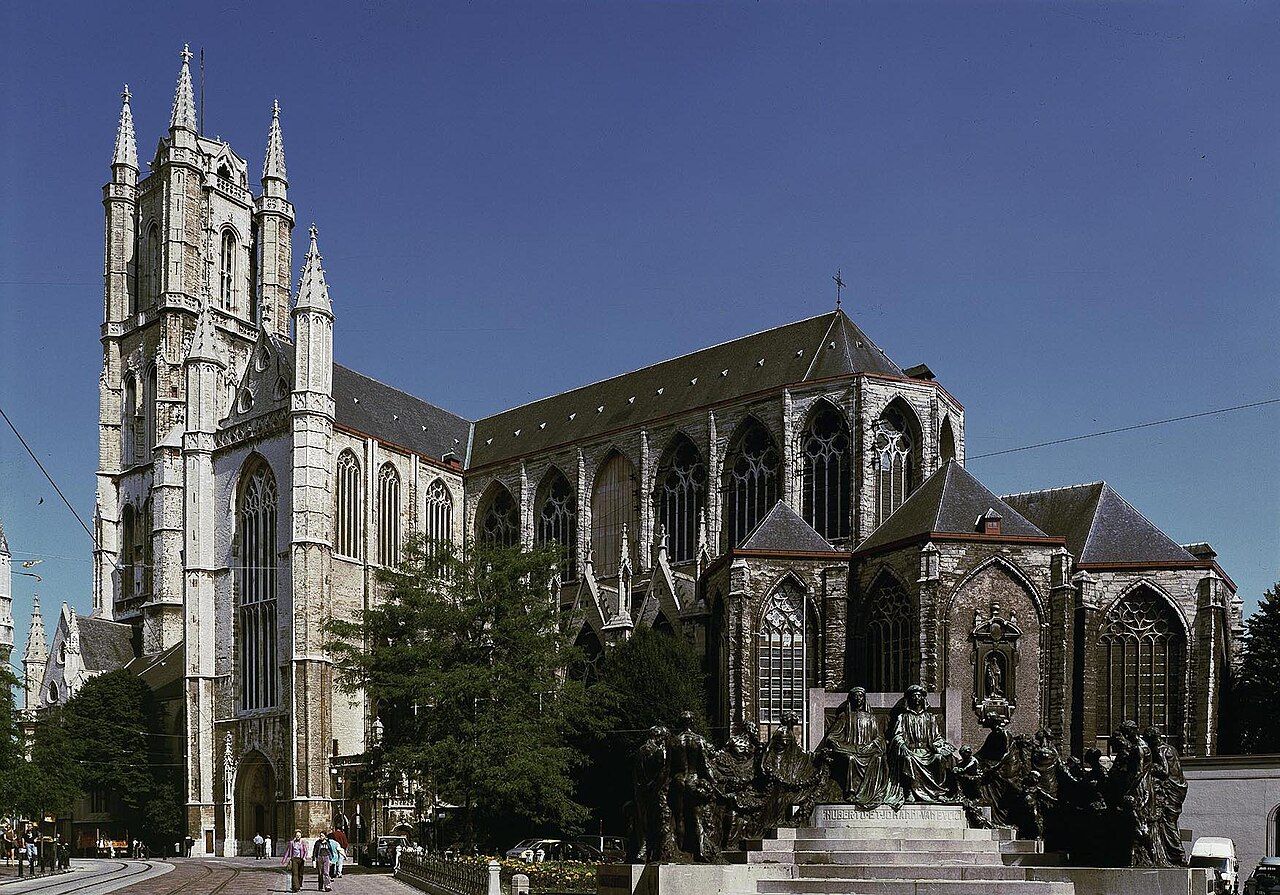
The Adoration of the Mystic Lamb was painted by Hubert and Jan van Eyck and finished in 1432. It hangs in St Bavo’s Cathedral in Ghent. The altarpiece is made of twelve panels, and its outer wings close over the inner scene. Those facts give us a way to look: start with the whole, then take the panels one at a time.
- Place: the cathedral quarter
- Time: an hour
- Where to see it: St Bavo’s Cathedral
- Display: a new visitor center inside the cathedral, since 2021
1. Morning
Begin with the arrangement, not with a hunt for a single detail. There are twelve panels, with outer wings that close over the inner scene. The closed wings are part of the work’s structure; the central image is revealed when those wings are open. Even before looking closely, it helps to keep both states in mind. The altarpiece is not one large picture broken into pieces, but a work whose panels form a larger whole.
Then bring the central panel into focus. A lamb stands on an altar. Crowds come from all sides to worship it. That is the scene’s clear center, and the movement around it gives the panel its shape: many people, approaching from different directions, gathered around the altar. We can stay with those few elements rather than trying to supply a story for every panel. The central image holds the attention; the rest of the work keeps its place around it.
The title, The Adoration of the Mystic Lamb, names this central scene. The brothers’ names and the finishing date belong in the same frame: Hubert and Jan van Eyck, 1432. They are useful points of orientation as we look from the central panel back to the full set of twelve. The altarpiece is presented as a complete work, even though its history includes a panel that is no longer the original.
2. Midday
The Just Judges panel brings that history into view. It was stolen in 1934 and has never been found. The panel in place today is a copy, painted in the 1940s. So the work seen now contains both the surviving panels and a replacement in the place of the missing original. We can name the loss plainly: the original Just Judges panel is still absent, while its position in the altarpiece is represented by the copy.
We keep the focus here on the cathedral rather than the counts' stone castle. The story inside St Bavo’s is already a sequence of its own: an assembled work, a theft, and a copy made for the empty place. The date 1934 marks the theft; the 1940s mark the copy. Those dates make the panel’s history part of what we see, without changing the central scene of the lamb and the worshippers.
Next on our list: A Full Day in Bruges from Ghent
3. Late afternoon
A long restoration began in 2012 and removed old overpaint. That detail gives us another way to think about looking at the panels. The work has not only been affected by what happened to one panel; it has also been worked on through restoration. We do not need to guess at what was beneath the overpaint or add a before-and-after story. The known point is enough: the restoration began in 2012, and old overpaint was removed.
Since 2021, the altarpiece has been shown in a new visitor center inside the cathedral. Its setting now brings the twelve panels together for viewing there. We can return to the outer wings, the central lamb, and the crowds coming from all sides, then set the history of the Just Judges panel alongside them. The visitor center is part of the present account of the work; the cathedral remains where the altarpiece hangs.
By the end of the hour, we come back to the simplest view: twelve panels, with the outer wings closing over the inner scene. In the center, the lamb remains on the altar, and the crowds face in from every side. The missing original and the copy have their place in the story too. We hold the whole arrangement in mind, panel by panel.